Village class divisions and collective conflict
The PeasantsVillage class divisions and collective conflict in Lipce are shaped by who owns land, who can obtain work or credit, and whose interests carry weight in village decisions. Scarcity presses wealthy farmers, smallholders, hired hands, and the landless into the same seasonal crises, but not on equal terms: some can sell livestock or wait for better times, while the poorest face hunger and unemployment. Collective protest becomes possible when these unequal experiences converge, yet the village’s solidarity remains fragile, divided by private advantage and by disputes over who has authority to act.
Economic hierarchy and seasonal precarity
The approach of winter makes class difference visible in ordinary calculations. Villagers debate which animals or grain to sell and how to afford clothing, tools, taxes, commune contributions, debts, and payments to servants. Even farmers with fifteen morgen struggle to meet their obligations; poorer households have still less room to maneuver. Some try to improve a cow’s appearance before taking it to market, while others make an old, bony horse seem saleable or thresh for days to prepare for the fair. The fair is not simply a festive occasion: it is a concentrated test of household solvency, when needs accumulate and ready cash is scarce.
Work is another dividing line. When the squire prepares to fell timber at Wolf’s Hollow, hired hands and families with little beyond a cottage hope the job will carry them through winter. At least twenty hired workers are said to need employment, while about five families depend on the prospect of the felling as their only local winter work. Yet the squire has arranged to hire men from Rudki, Modlica, Dębica, and Rzepki, leaving Lipce workers out. The exclusion turns a labor decision into a village grievance: people who expected access to work see outsiders contracted while their own households face frozen potatoes, dwindling stores, and a long wait before the next harvest.
The hardship is not confined to those without land. Antek Boryna’s household, expelled from the paternal homestead, subsists on potatoes and salt, has no money, and is close to selling its cow. Hanka Borynowa nurses a child while weighing the family’s need for income against Antek’s refusal to take hired work. Their distress shows how poverty can narrow choices even for people who have known a farmstead of their own. It also exposes gendered burdens: Hanka imagines that, if she were a man, she would work without sparing herself to preserve the cow and keep the family through winter.
Divisions within the village
Lipce does not divide neatly into rich farmers and poor laborers. Some middling households conceal their poverty to preserve their standing with wealthier neighbors and support the latter’s position. Hired hands and cottage owners take whatever work they can find—threshing for farmers or wielding an axe at the mill—while the poorest families may have no winter employment at all. Their interests are therefore not automatically represented by those who own land or hold village authority.
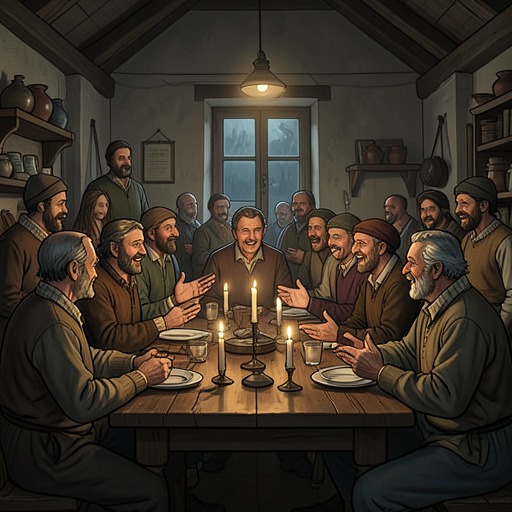
The tavern makes these divisions legible in a crowded public space. At a gathering attended by men from Rzepki, Bartek from the Sawmill reports the priest’s response and denounces the squire, while Wojtek Kobus echoes him. The Rzepki visitors, expected to work in the forest the next day, remain at their tables without openly answering the criticism. Many Lipce farmers turn away from the argument rather than take it up; in the packed room, people can choose their own company and buy where they please. Jagustynka moves between groups, spreading gossip and mocking, but the scene offers no simple image of a united village. Proximity creates an audience for grievance, not agreement.
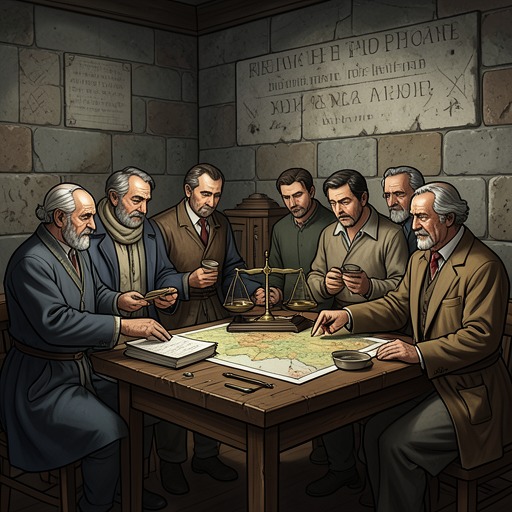
The council over the forest reproduces this tension. When Antek asks what the meeting at Kłąb’s resolved, he hears that the participants complained but reached no decision beyond opposing the felling. Younger villagers also criticize older landowners for withholding land from their children and for managing the forest dispute badly. Grzela Rakoski argues that the village should seek a lawyer rather than use violence, warning that direct resistance could send them to jail; the others are impatient with his caution. Their disagreement is not only about tactics. It concerns who can speak for Lipce, whether customary claims should be negotiated or defended, and whether the consequences of resistance will fall equally on everyone.
From private hardship to collective resistance
As the planned logging approaches, shared anger briefly overcomes the village’s hesitation. A crowd gathers outside the inn and waits for Boryna, regarded as the leading farmer whose participation gives the movement authority. The squire’s refusal to hire local workers joins the dispute over the forest itself: villagers remember earlier injuries and unsuccessful complaints, and see the felling as a further denial of their claims. Antek calls on farmers and hired hands to defend what they regard as theirs. The appeal turns separate grievances into a common course of action, and the crowd leaves to prepare.
The resulting procession makes the breadth—and the seriousness—of the mobilization visible. Peasants, farmhands, women, and some older children set out by sleigh, horse, cart, and on foot. They carry stout poles, pitchforks, flails, and scythes. Boryna leads from his sleigh with other village leaders, and the company departs after he crosses himself. This is collective action on a village scale, but it is not evidence that Lipce’s economic divisions have disappeared: the coalition forms around an immediate threat to work and forest access, drawing different groups into the same confrontation without making their circumstances identical.
The episode also shows that collective action has costs beyond the moment of confrontation. After the forest conflict, the village’s working men are imprisoned, leaving households without labor just as spring demands it. Women must manage livestock, childcare, fuel, gardens, and fields; many cannot complete the agricultural work alone, and some are pregnant or due to give birth. The spring earth is ready for sowing, but the labor force needed to cultivate it is in jail. The absence of workers converts a public dispute into a crisis of household survival and threatens the next harvest.
Mutual aid and its limits
The imprisonment reveals both the reach and the unevenness of community obligation. In a poor household visited by Jagustynka, a daughter is near death from hunger; the family has no potatoes, has sold its quilt, and must beg groats from the miller. In another, a woman gives birth while sick and without money or milk to feed the child. With family members imprisoned and fields standing fallow, ordinary hardship becomes sharper. Jagustynka condemns the better-off farmers for concentrating on their own food and lending arrangements while leaving their poorer neighbors to divine care. Her account names a moral failure within the community: people live close together, yet proximity does not ensure help.
Material cooperation nevertheless becomes possible when neighboring villages come to Lipce’s aid. Their arrival revives the empty fields: carts roll out, ploughs move along the paths, and villagers work across the potato patches, barley fields, stubble, and fallow ground. After the first noisy bustle, the ploughs enter the soil and the workers sow, entrusting the crop to the earth. This assistance offers a counterpoint to the village’s internal divisions. The shared need for labor can produce practical solidarity, though it does not undo the poverty or the conflict that made such help necessary.
Authority, voice, and the meanings of unity
Lipce’s collective conflicts extend beyond land and employment into the question of who is expected to obey. At a meeting over the proposed school, the notary calls for someone to run an errand to the manor, but no one moves; a villager answers that they did not come to run messages. The refusal is small in form but significant in its rejection of automatic deference. In a separate confrontation, a crowd closes around the Gendarmerie and then surges after them toward the prefect, voicing resentment that peasants must use another’s language and submit to orders. Such moments present collective action as a struggle over dignity as well as material interest.
The novel therefore treats village unity as both a force and a problem. Shared exposure to winter scarcity, exclusion from work, land pressure, and official authority can bring people together in a forest procession or in practical labor. But wealth, landholding, concealed poverty, private interest, and unequal capacity to bear risk continue to separate them. Lipce’s collective conflicts are most revealing when solidarity is neither assumed nor celebrated as complete: it has to be assembled, contested, and sustained, and its failures are measured most starkly in the hunger and unfinished labor borne by the poorest.